

Table of Contents
- Key Takeaways
- Can You Write Off a Storage Unit on Taxes?
- Who Can Deduct a Storage Unit?
- What Business Storage Expenses Qualify?
- Where Does a Storage Unit Go on Your Tax Return?
- Storage Unit vs. Home Storage: How the Rules Differ
- What If You Store Business and Personal Items in the Same Unit?
- What Do You Need to Write Off a Storage Unit?
- How Much Can a Storage Unit Write-Off Actually Save?
- What to Look for in a Business Storage Unit
- Put Your Storage Unit to Work for Your Business
- FAQs
You pay for your storage unit every month. If it holds inventory, tools, or business files, that rent starts to look a lot like a business expense. So can you write off a storage unit on taxes?
In many cases, yes. A storage unit can be deductible when you use it for an ordinary and necessary business purpose, like holding inventory, equipment, or records. A unit that holds personal belongings, like furniture from a move or holiday décor, generally isn't.
This post is general information, not tax advice. Tax rules change, and your situation is unique, so talk with a qualified tax professional before you claim any deduction.
Shopping for a unit to support your business? Explore business storage at Storage Star.
Key Takeaways
- You can usually write off a storage unit on taxes when it's used for your business, not for personal belongings.
- Self-employed renters typically report storage rent on Schedule C as rent for other business property.
- Most W-2 employees can't deduct storage on their federal return, even if the unit holds work items.
- Moving storage is deductible only for certain military and intelligence community members, not for most households.
- Keep your lease, receipts, payment records, and an inventory log, and hold onto them for at least three years.
Can You Write Off a Storage Unit on Taxes?
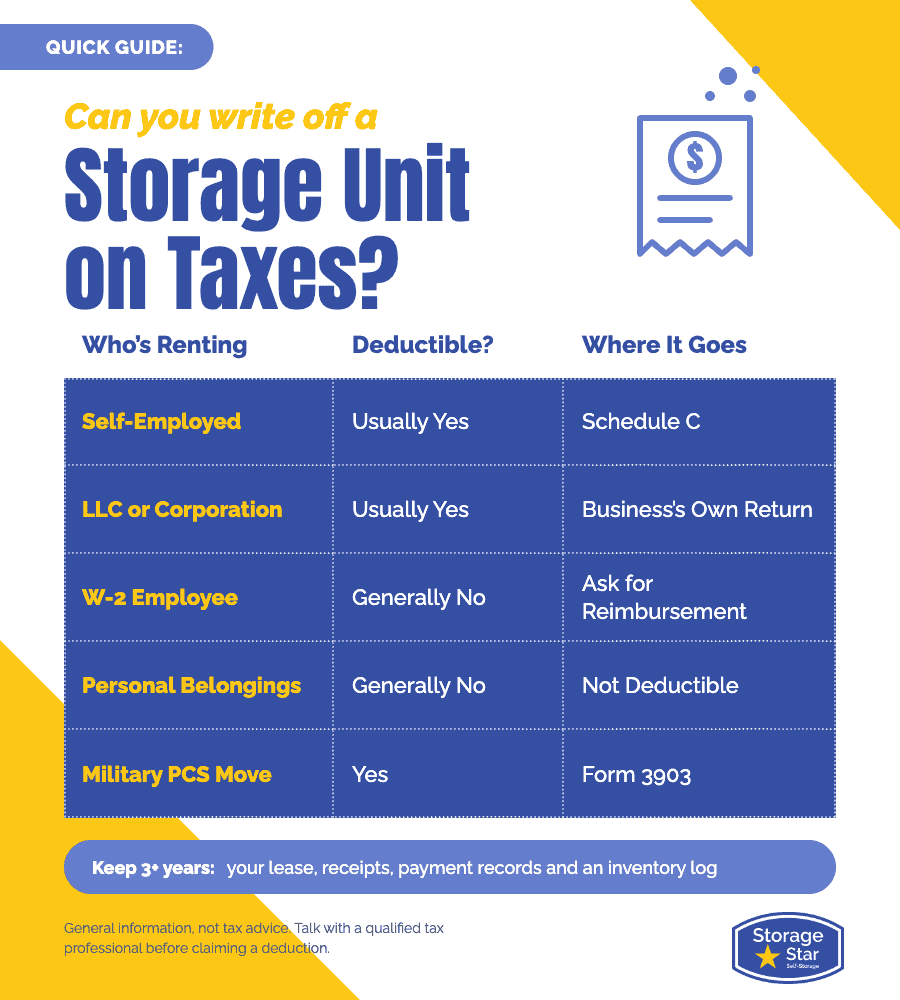
You can write off a storage unit on taxes when the unit is an ordinary and necessary expense of your trade or business. If the unit holds personal items, the rent is a personal expense and isn't deductible. The deciding factor is what's inside the unit and why you're paying for it.
The IRS uses two plain-language tests. An ordinary expense is one that's common and accepted in your field, and a necessary expense is one that's helpful and appropriate for your business. A contractor storing ladders and power tools between jobs passes both tests easily. So does an online seller keeping overflow stock in a unit across town.
Personal storage is a different story. Renting a unit to clear out the garage, hold furniture during a renovation, or keep a late relative's belongings is a household expense, even though it costs the same as a business unit.
Who Can Deduct a Storage Unit?
Whether you can deduct a storage unit depends on how you earn your income. Self-employed renters and business owners have the clearest path, while most employees don't qualify at all.
Self-Employed Renters and Sole Proprietors
If you're a freelancer, independent contractor, or sole proprietor, storage rent for business use generally counts as a business expense. Photographers storing gear, lawn care pros keeping equipment, and resellers holding inventory all fit this group. You'd typically report the cost on Schedule C with your other business expenses.
Small Business Owners
Businesses of every size rent storage for files, inventory, fixtures, and equipment. If your company operates as an LLC, partnership, or corporation, the storage expense generally goes on the business's own return rather than your personal one. Your accountant can confirm exactly where it belongs for your entity type.
W-2 Employees
Most W-2 employees can't deduct a storage unit on their federal return, even when it holds work-related items. IRS Publication 529 states that unreimbursed employee expenses can no longer be claimed as miscellaneous itemized deductions, with only a few narrow exceptions. If your employer asks you to store work materials, ask whether they'll reimburse the cost instead.
Military and Intelligence Community Members Who Are Moving
Storage during a move is generally not deductible for most households. There's one important exception. Active-duty members of the Armed Forces who move under military orders for a permanent change of station may deduct unreimbursed moving expenses, including storage, according to the IRS. Intelligence community employees and new appointees qualify too for moves in 2026 or later. These expenses are figured on Form 3903. If you're relocating with the military, Storage Star's military storage units can hold your belongings between stations.
What Business Storage Expenses Qualify?
Business storage expenses usually qualify when the unit holds items your business needs to operate. The key is a clear connection between what's stored and how you make money. Here are common examples:
- Inventory and overstock: Extra product for an online store or retail shop. Storage Star offers dedicated inventory storage for this.
- Tools and equipment: Gear for trades and contractors between jobs, including contractor storage with drive-up access at select locations.
- Business records: Client files, financial documents, and paperwork you're required to keep.
- Seasonal stock: Displays, merchandise, and supplies you use only part of the year.
- Office furniture and fixtures: Desks, shelving, and equipment during an office move, downsizing, or remodel.
Insurance on stored business property may be a separate expense to discuss with your tax pro. Our storage unit insurance guide covers how protection for stored items works.
Where Does a Storage Unit Go on Your Tax Return?
For self-employed renters, storage unit rent typically goes on Schedule C (Form 1040). Business entities like partnerships and corporations report expenses on their own returns instead.
Keep storage rent separate from home office expenses. A storage unit is rented property away from your home, so it isn't part of the business use of home deduction on line 30. Mixing the two can lead to double counting, which is exactly what you want to avoid.
Storage Unit vs. Home Storage: How the Rules Differ
Storing business items at home follows a different set of rules than renting a separate unit. The home office deduction has specific requirements, while a rented storage unit is treated more like any other business rental.
The IRS allows a home storage deduction when you regularly use part of your home to store inventory or product samples, as long as your home is the sole fixed location of your business. Unlike other home office uses, exclusive use isn't required for storage.
If you use the simplified method, the deduction is $5 per square foot, up to 300 square feet of the home used for business. That works for a spare room of shipping boxes. Once inventory spills into the hallway, a separate unit can keep your home livable and your business organized.
What If You Store Business and Personal Items in the Same Unit?
Storing business and personal items together makes your deduction harder to support. Only the business portion of the cost can be a business expense, and you'll need a reasonable way to show what that portion is.
The simplest fix is to keep two units, one for business and one for personal use. If that's not practical, keep business items in a clearly separated area, document what's stored, and ask your tax pro how to divide the cost. Clean records now save a lot of explaining later.
What Do You Need to Write Off a Storage Unit?
To write off a storage unit, keep records that prove what you paid and why the unit serves your business. Good records turn a gray area into a clear expense.
- Your rental agreement, ideally in your business name if you have one
- Monthly invoices or receipts
- Payment records, preferably from a business bank account or card
- An inventory log listing what's stored and how it's used in your business
- Photos of the unit's contents, updated when things change
As for how long to keep them, the IRS generally recommends 3 years. That stretches to 6 years if you underreport income by more than a quarter of the gross income on your return, 7 years if you claim a loss from worthless securities or a bad debt deduction, and indefinitely if you don't file a return or file a fraudulent one.
How Much Can a Storage Unit Write-Off Actually Save?
A storage unit write-off lowers your taxable income, not your tax bill dollar for dollar. Your savings depend on your marginal tax rate, which is the rate on your last dollar of income.
Here's a hypothetical example. Say you paid $1,200 in business storage rent this year and your marginal federal income tax rate is 22%. The deduction would lower your federal income tax by about $264. Your actual savings could differ based on state taxes, self-employment taxes, and the rest of your return, so run the numbers with your tax pro.
What to Look for in a Business Storage Unit
The right business storage unit makes it easy to get in, get what you need, and get back to work. Storage Star's business storage is built around that. Features vary by location, so check your local facility for details.
- Drive-up access for loading straight from your truck or van, available at select locations
- Climate-controlled units for electronics, documents, and temperature-sensitive inventory
- Month-to-month leasing, so you can scale up or down as your business changes
- Gated facilities with 24/7 video surveillance
- Private and flex office space at select locations
Not sure what size you need? The storage unit size guide and our tips on choosing a business storage unit can help you match a unit to your stock. If you store electronics or paper records, a climate-controlled storage unit is worth a look.
Put Your Storage Unit to Work for Your Business
A storage unit that supports your business can do double duty. It frees up space at home or in the shop, and it may lower your tax bill too. Ready to find the right space?
This post is for general information only and isn't tax, legal, or accounting advice. Consult a qualified tax professional about your specific situation.
FAQs
Can You Write Off A Storage Unit On Taxes?
Yes, you can write off a storage unit on taxes when you use it for an ordinary and necessary business purpose, such as storing inventory, tools, or business records. Personal storage isn't deductible. Self-employed renters typically report business storage rent on Schedule C.
Is A Storage Unit Tax Deductible For Personal Use?
No, a storage unit used for personal belongings generally isn't tax-deductible. That includes storage during a home renovation, a move, or a decluttering project. The main exception is storage tied to a qualifying military move or, for moves in 2026 or later, an intelligence community move.
Can I Claim A Storage Unit On My Taxes If I'm Self-Employed?
Yes, if the unit holds items you use in your business. Freelancers, contractors, and sole proprietors can generally deduct storage rent as a business expense on Schedule C. Keep your lease, receipts, and an inventory log to support the deduction.
Can I Store Business Inventory At Storage Star?
Yes. Storage Star offers business storage for inventory, equipment, files, and supplies, with drive-up and climate-controlled options at select locations. Learn more about inventory storage or find a self-storage facility near you.
Does Storage Star Offer Month-To-Month Business Storage?
Absolutely! Storage Star offers month-to-month leasing, so your business can rent for as long as it needs space. You can sign your lease online and scale up or down as your inventory changes. Explore business storage to get started.