
Table of Contents
Good doll storage comes down to four things: steady temperature, low humidity, little light, and breathable wrapping. Dolls kept that way, whether in a closet at home or a climate-controlled unit, stay much closer to how they looked when they were packed.
You might be packing for a move, clearing a childhood bedroom, or finally giving a collection a proper home. Dolls are different from most things you box up. They combine vinyl, fabric, hair, and tiny accessories that react to heat, moisture, and each other. This guide covers what each material needs, how to prepare and pack dolls, and where they do best, including a storage unit. Where collectors and experts disagree, the FAQ at the end lays out each side.
What Do Dolls Need to Stay in Good Condition?
Dolls need a stable, cool, dry space with little light and some airflow. Moisture and heat cause most storage problems, and sunlight fades fabric and hair.
Museum guidance offers a useful yardstick. The National Park Service says relative humidity should always stay below 65 percent, and holding it between 45 and 55 percent makes mold growth less likely. Keeping temperature and humidity as constant as possible matters as much as the exact number, because swings are what push moisture into fabric and hair.
Why Vinyl Dolls Need Air
Vinyl is the main reason breathable storage matters. Many Barbie, American Girl, and other modern dolls have vinyl heads, limbs, or bodies. Vinyl is a plastic made flexible with additives called plasticizers. Over time those additives can move to the surface and leave a tacky, glossy film.
A 2022 study of Barbie dolls made between 1959 and 1976 found that the first Barbie, produced in 1959, used plasticized PVC. Plasticizer migration shows up as a tacky exudate on the surface. Later dolls moved to more stable plastics, though the same study notes that additive migration still occurs in them to a lesser degree. Collectors sometimes call the result “plastic doll disease.”
Stable conditions help slow the process. When conservators at UCLA treated a first-edition 1959 Barbie, they housed her with archival materials in a monitored environment to slow further change.
Light, Dust, and Handling
Family Tree Magazine notes that direct sunlight can fade doll clothing and hair, and that fluorescent light can turn vinyl dolls green. Indirect lighting is the safer choice for any doll on display. The same guide suggests rotating which dolls are out, and washing your hands and skipping lotion before you handle a doll.
How to Prepare Dolls for Storage
Prepare dolls by cleaning them gently, letting everything dry completely, photographing each doll, and wrapping it in acid-free tissue or soft cotton. A little prep keeps one doll’s clothing, dye, or dust from affecting the next.
- Clean gently. Cleaning methods vary by material, so match the method to the doll: porcelain, bisque, vinyl, and cloth bodies each need different care. For antique or valuable pieces, ask a doll hospital or conservator first.
- Dry completely. Moisture is what mold needs, so let dolls, hair, and clothing air-dry fully before anything gets wrapped.
- Photograph and record the story. Family Tree Magazine suggests writing the doll’s history on acid-free paper and placing it in the storage box. Who gave her to you and when is part of what you are keeping.
- Check for pests. Inspect wigs and clothing for insects or eggs before packing, since both can nest in hair and fabric.
- Keep originals together. Original clothing, shoes, and accessories add value and sentiment, so store each doll’s set together in a labeled cotton pouch or small box.
- Wrap each doll separately in acid-free tissue or soft cotton, with extra cushioning outside that first layer. Dark or brightly dyed fabrics stay on their own tissue layer, away from pale clothing and bare vinyl.
Doll Storage Ideas by Doll Type
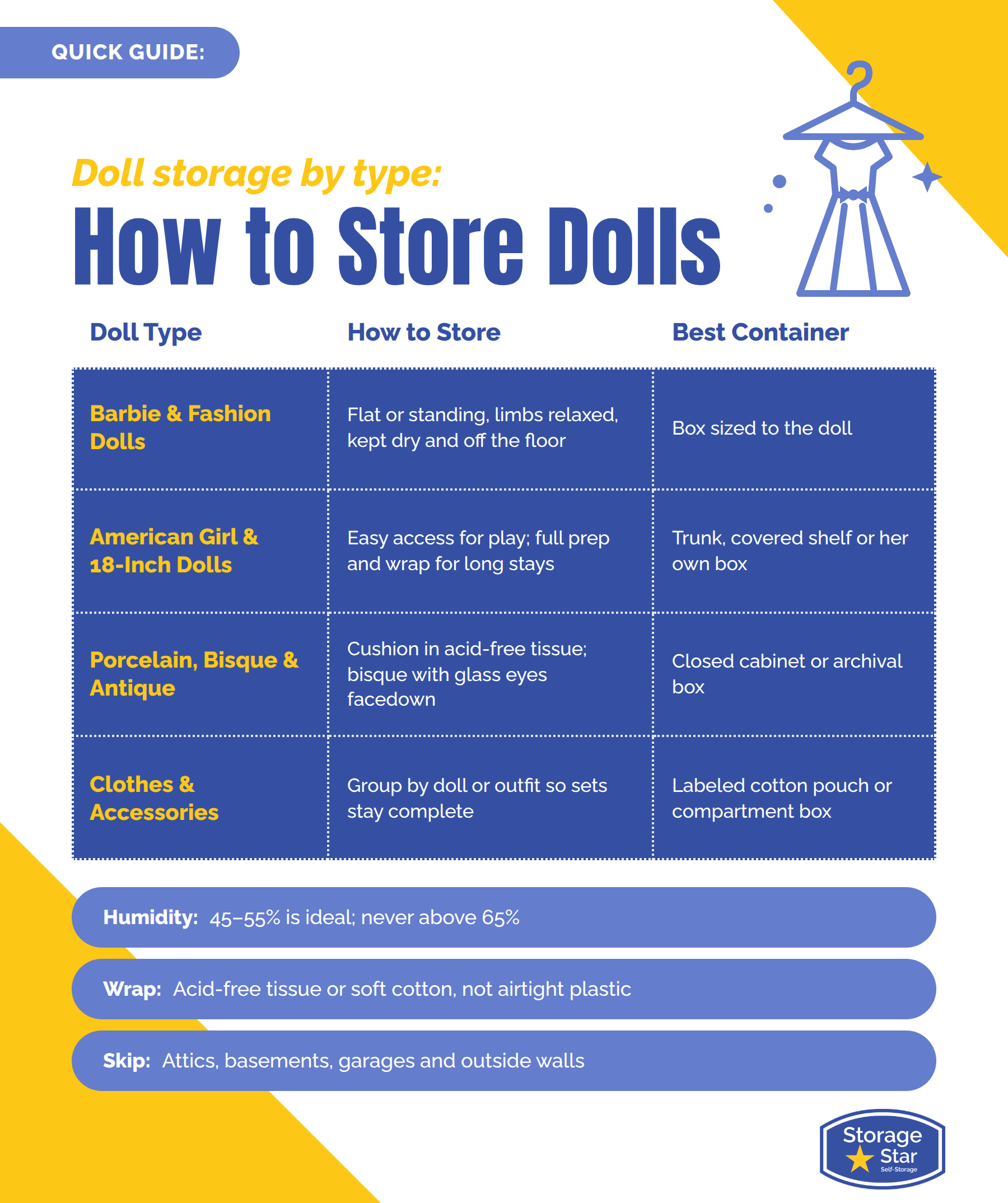
The right container depends on the doll. Fashion dolls and 18-inch dolls do well in labeled boxes sized to fit, antique dolls need individual cushioning, and clothes and accessories need an organized home of their own.
Barbie and Other Fashion Dolls
Fashion dolls store well flat or standing in a box sized to the doll, with limbs relaxed rather than bent. Collectors split on whether to keep dolls in their original packaging; the FAQ on box versus out covers both views. If a doll is staying boxed, keep the box dry and off the floor, and expect the packaging itself to need the same care as the doll.
American Girl and 18-Inch Dolls
A doll that plays every week needs easy access, not archival boxes. A trunk, a shelf with a cotton cover, or a doll bed works well for dolls in rotation, with each doll’s outfits grouped together so sets stay complete. A doll that is heading into storage for months or years should get the full prep steps above and a box of her own.
Porcelain, Bisque, and Antique Dolls
Antique dolls do best in closed cabinets or archival boxes, away from pets, dust, and sunlight. Family Tree Magazine recommends cushioning them with acid-free tissue or cloth, and turning bisque dolls with glass eyes facedown in their boxes.
Doll Clothes and Accessories
Doll wardrobes multiply faster than anyone plans, and collectors joke about it on every forum. Sort by doll or by outfit, then store each group in a labeled box or cotton pouch. Keep shoes, hats, and tiny accessories in a small compartment box so nothing gets separated from its set. Hanging organizers work well for everyday play outfits, while special pieces belong in tissue inside a box.
Where to Store Dolls at Home
The best spot is an interior closet or cabinet in the temperature-controlled part of your home, away from windows and outside walls. Attics, basements, and garages swing the most in temperature and humidity.
The National Park Service advises avoiding storage in or near damp areas such as attics and basements. It also recommends keeping items at least four inches above the floor and off outside walls, where humidity, condensation, and leaks are more likely. A closet shelf or a sturdy rack that lifts boxes off the floor covers most of that.
If you are saving childhood dolls for a daughter or grandchild, a labeled box on a closet shelf with a note about the doll’s story is often all it takes. When the closet is full, or the dolls need to leave the house for a while, that is where a unit comes in.
Can You Store Dolls in a Storage Unit?
Yes. A storage unit can be a good home for dolls when you prepare them well and choose the right kind of unit. Climate-controlled units hold a steadier temperature than outdoor units, which makes them the usual choice for dolls and other keepsakes.
Storage Star’s climate-controlled storage units are typically kept between 55 and 80 degrees Fahrenheit, and most are indoors. Availability varies by location, so check with your local facility. Museum guidance aims for cooler and narrower ranges than most units hold, so wrapping and shelving still do real work for dolls you treasure.
Collectors share mixed stories about unit storage. In one forum discussion, some report dolls and clothing coming through years in an ordinary unit in good shape, while others point to heat wearing out elastic and shoes. These are individual accounts, not tests, and the common thread is that steadier conditions help.
Many people only need a unit for a stretch: a move, a remodel, or a season between homes. Dolls do best when you pack them as if they will be there for years, even if the plan is a few months.
How to Pack Dolls for a Storage Unit
- Choose sturdy boxes sized to the doll, lined with acid-free tissue. A box that fits keeps a doll from shifting without squeezing limbs or hair.
- Put one layer of acid-free tissue or soft cotton against the doll, and any cushioning outside that layer. Give each doll its own wrapping so clothing dyes and surface films do not touch.
- Close the box without sealing it in airtight plastic. Family Tree Magazine warns that airtight plastic containers risk mold and mildew, so breathable boxes are the safer default for vinyl and antique dolls. The FAQ on plastic bins covers how families and collectors see it.
- Label the outside with the doll’s name and contents, and photograph the doll before the lid goes on.
- Shelve boxes off the floor and away from outside walls, with nothing heavy on top. Use the storage unit size guide to match your boxes to a unit size.
- Visit and look inside regularly. Museum guidance recommends routine inspection for visible mold or a musty smell, since catching a change early is far easier than reversing it.
For locks and packing supplies, see Storage Star’s moving and packing supplies and ask your facility about tenant protection and insurance options.
Ready to compare options? Explore climate-controlled storage or find self storage near you to see what your local Storage Star offers.
Find the Right Storage Unit for Your Doll Collection
Whether you are boxing up a childhood collection or protecting dolls through a move, the right space makes the difference. Browse climate-controlled storage, use the size guide to match your boxes to a unit, and find self storage near you to reserve online. Looking for more ideas on what else belongs in a unit? See Storage Star’s household storage options.
FAQs
What Is the Best Doll Storage Setup for Long-Term Care?
The best doll storage is a cool, dry, dark, stable space, with each doll wrapped in acid-free tissue or soft cotton and kept in a closed, breathable box or cabinet. Keep boxes off the floor and away from outside walls. Museum guidance sets relative humidity below 65 percent as a firm limit, and an interior closet or a climate-controlled unit can both meet that goal.
Should Dolls Be Stored in the Original Box or Taken Out?
Collectors and conservators answer this differently, and each side has reasons. Many collectors keep the box because it protects the doll, helps with moving, and supports resale. As one forum thread shows, plenty believe true collectors keep the box, while others find boxed dolls hard to enjoy and keep them out. Conservator guidance for long-term preservation, from the Connecting to Collections care community, prefers removing the doll after photographing it and storing her flat in an acid-free box with padding. If the original box has to stay, that guidance suggests an acid-free board barrier inside it and a second acid-free box around it. Space matters too, since one collector found that even flattened boxes take up a lot of room.
Are Plastic Bins Safe for Storing Dolls and Doll Clothes?
It depends on who you ask and what is inside. Many families use clear bins for clothes and accessories because bins stack and show their contents, while collector and heirloom guides advise against airtight plastic around dolls. Family Tree Magazine notes that airtight plastic containers put dolls at risk for mold and mildew. A practical compromise is bins for sturdy play items, and breathable archival boxes for treasured, vintage, or vinyl dolls.
Can You Store Dolls in a Storage Unit, and What Type and Size Do You Need?
Yes, many people store dolls in units, and a climate-controlled unit is the usual choice because it holds a steadier temperature. Storage Star’s climate-controlled units are typically kept between 55 and 80 degrees Fahrenheit, and availability varies by location. Match your packed boxes to a size with the storage unit size guide, then find self storage near you to see what is open at your local facility. Collector experiences with units vary, so pack dolls as you would for any long stay.
Do Attics, Basements, and Garages Harm Dolls?
They are the spots museum guidance advises against, though collector experiences vary. The National Park Service recommends avoiding attics, basements, floors, and outside walls because humidity, condensation, and leaks are more likely there. Some collectors report dolls stored for years in garages or attics in good shape, and others have found dampness or heat damage. Moisture and temperature swings matter more than the room itself.
Should Dolls Be Stored Dressed or Undressed?
Both approaches are common. Storing dolls dressed keeps outfits, shoes, and accessories together and saves wrapping time. Collectors who store dolls undressed worry about dye moving from fabric to vinyl, a concern raised in forum discussions about storing clothes, especially with dark or bright fabrics. A middle path is a layer of acid-free tissue between clothing and doll, or storing the outfit in the same box beside her. Family Tree Magazine adds that original clothing and accessories add value, so keep them with the doll either way.
Can a Doll With Mold Be Saved?
It depends on the doll and how far the mold has spread, and experts disagree. One doll restorer told the Bedford Citizen that there is just no saving moldy dolls. The American Girl Care Center, meanwhile, says it refreshes and restores dolls. One owner described a successful trip to a doll hospital after finding mold on her childhood dolls. Museum guidance says not to touch the mold, to isolate the object, and to contact a conservator.
Prevention is the simpler path: dry dolls, steady humidity, and regular checks.
Why Do Some Vinyl Dolls Get Sticky, and Does It Come Back?
Stickiness usually comes from plasticizers migrating to the surface of vinyl, a process documented in early Barbie dolls. Collectors report that cleaning removes the film, though some say it can resurface within a year. Conservators focus on slowing the process with stable, monitored storage rather than expecting a permanent fix.